
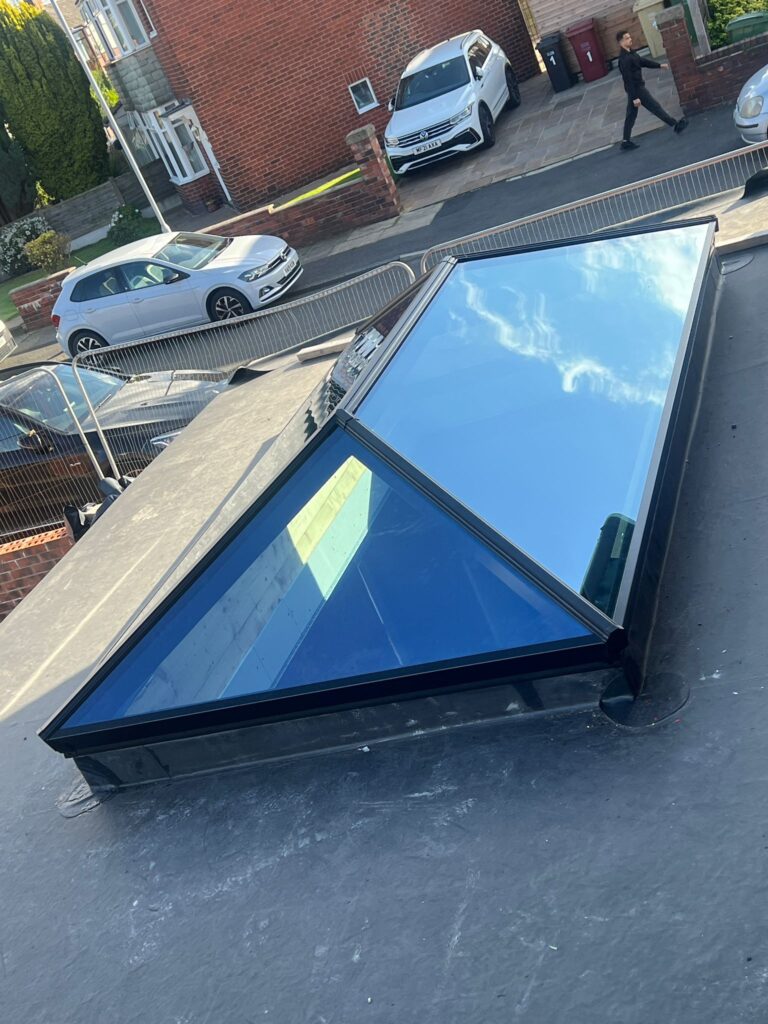
A roof lantern is one of the most effective ways to flood a room with natural light. Sitting on a flat roof, its pitched glass panels capture daylight from every direction, turning dark kitchens, extensions and orangeries into bright, welcoming spaces.
In this complete guide, our roof lantern installers explain the benefits, the main frame and glass options, planning and Building Regulations considerations and what to expect during installation.
What Is a Roof Lantern?
A roof lantern is a glazed structure with sloping sides that rises above a flat roof, usually fitted onto a raised upstand (kerb). Traditional lanterns have a ridge running along the top, while modern designs may be pyramid-shaped or have slim, minimalist profiles.
Unlike a flat rooflight, a lantern’s angled panels let in light throughout the day and add a striking architectural feature both inside and out.
Benefits of a Roof Lantern
- More natural light – light enters from several angles, brightening the whole room
- Sense of height and space – the raised glass draws the eye upwards and makes rooms feel larger
- Stylish feature – adds character to extensions, kitchens and orangeries
- Energy savings – more daylight means less reliance on artificial lighting
- Added value – bright, well-designed extensions are attractive to buyers
- Optional ventilation – some lanterns can include opening vents
Where Do Roof Lanterns Work Best?
- Single-storey kitchen and dining extensions
- Orangeries and garden rooms
- Flat-roofed living areas with limited wall space for windows
- Hallways and open-plan spaces that lack daylight
- Commercial premises such as shops and cafés
Aluminium or uPVC Roof Lanterns?
Aluminium roof lanterns
- Very strong, allowing slim frames and more glass
- Sleek, contemporary appearance
- Available in a wide range of colours, often with different colours inside and out
- Long-lasting and low maintenance
uPVC roof lanterns
- Cost-effective option
- Good thermal performance
- Available in white and popular colours
- Slightly chunkier frames than aluminium
For most modern extensions, aluminium is the popular choice because of its slimmer sightlines. uPVC offers excellent value where budget is a priority.
Choosing the Right Glass
Because roof lanterns face the sky, the right glass makes a big difference to comfort:
- Solar control glass – reduces heat build-up and glare in summer
- Self-cleaning glass – a special coating helps rain wash away dirt
- Low-emissivity (Low-E) glass – reflects heat back into the room in winter
- Toughened and laminated safety glass – essential for overhead glazing
- Tinted options – blue, grey or neutral tints for extra glare control
Learn more about safety glass in Toughened vs Laminated Glass: What Is the Difference?
Brighten Your Extension With a Roof Lantern
We supply and install aluminium and uPVC roof lanterns across Bolton and the North West. Get expert advice and a free, no-obligation quote.
Get a Free Quote →Call 01204 929995Mobile 07538 056353Do You Need Planning Permission for a Roof Lantern?
This is general guidance for houses in England – always check with your local council if you are unsure.
Roof lanterns are often installed as part of a single-storey extension. If the extension itself falls under permitted development, the lantern is usually considered as part of the design. However, because lanterns project above the roof, it is worth checking before adding one to an existing roof, particularly if:
- Your home is a listed building or in a conservation area
- The lantern would be visible from the road on a prominent elevation
- Permitted development rights have been removed
- The property is a flat or maisonette
Building Regulations
Building Regulations normally apply when a new roof lantern is installed. Key considerations include:
- Structural support – the opening must be properly framed, sometimes with new joists or steelwork
- Thermal performance – the lantern must meet energy efficiency standards
- Safety glazing – overhead glazing must be suitable safety glass
- Weatherproofing – the upstand must be correctly sealed into the flat roof covering
What Does Installation Involve?
- Survey – we measure the roof, check the structure and discuss size, style and glass options
- Manufacture – the lantern is made to measure
- Preparing the opening – the roof is opened up and trimmed, and an insulated upstand (kerb) is built
- Weatherproofing – the flat roof covering is dressed up and sealed around the upstand
- Fitting the lantern – the frame and glazing are installed and sealed
- Finishing – internal plastering and decoration complete the job
A standard installation is usually completed in one to two days once the opening is ready.
Roof Lantern Care and Maintenance
- Clean the glass a few times a year, or rely on self-cleaning glass to reduce effort
- Keep the flat roof and gutters clear of leaves and debris
- Check seals periodically for signs of wear
- Wipe down frames with warm soapy water
Common Roof Lantern Problems
Most issues come from poor installation – leaks around the upstand, condensation from inadequate insulation or misted glass units where seals have failed. Misted units can usually be replaced without replacing the whole lantern – see our misted glass repair service and our guide What Causes Misted Double Glazing?
Roof Lantern FAQs
How big should my roof lantern be?
It depends on the size of the room and roof. As a rough rule, many designers aim for a lantern that is in proportion to the room below, leaving enough roof around it for structure and drainage. We will recommend the best size during the survey.
Will a roof lantern make my room too hot?
Solar control glass greatly reduces heat gain and glare, keeping the room comfortable in summer.
Can a roof lantern be added to an existing flat roof?
Yes, in many cases, provided the roof structure can be adapted. We will assess this during the survey.
Can I add new doors at the same time?
Absolutely. Many customers combine a roof lantern with new patio doors or French doors – see French Doors vs Patio Doors.
Related Guides
Let the Light In With a New Roof Lantern
From sleek aluminium designs to cost-effective uPVC lanterns, our team will help you choose and install the perfect roof lantern. Get your free quote today.
Request Your Free Quote →📞 01204 929995Serving Bolton, Bury, Wigan, Salford, Manchester, Westhoughton, Farnworth and across the North West.